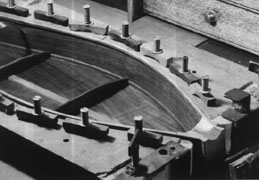
Inside the Dulcimer Building Jig
After the back, top, sides, tailblock, and peghead are chosen and given a final sandpaper finish, they are assembled into the building mold.
Here these pieces get acquainted with each other for the first time and begin slowly assuming their hour-glass or teardrop shape. Time and gradually increasing pressure ease the wood into its final shape, as the sides of the building mold are daily drawn a little closer together.
No heat or water-soaking is used to form the dulcimer body. These measures rob the wood of its acoustic dynamics. Each piece of wood in a Bear Meadow dulcimer is taut, like a bow, so that when played it springs instantly into life. This accounts, in part, for the unusual projection and power of the dulcimers built at Bear Meadow Folk Instruments. The wood, being taut, does not dissipate energy in useless flabbiness, but radiates it all throughout every part of the instrument and out into the air as acoustic energy.
The ribs, being only about 070" - .080" thick, bend easily into the mold form, and over the coming days become resigned to their fate, and no longer keep on trying to straighten out with so much vigor. But the building process does not wait on the ribs' acquiscence. We start assembly immediately, building in -- and using -- that tension.