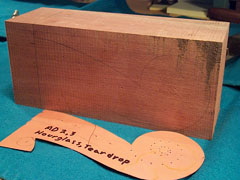
Marking the Peghead Block
We choose a block of best instrument-grade quartersawn black walnut The block is squared up all around, and carefully marked. We are laying a foundation that we will invest a lot of work in, so we want to make sure we've done everything we can to make the carving go easily. No odd grain problems, no out-of square geometry problems.
First we mark the block as shown above, defining the scroll and the outer profile of the peghead. We want these markings to be very carefully done. We will be marking the scroll on both sides of the blank, and that is the founding symmetry of the peghead.
 Then we drill for the pegs. If we are fitting wooden pegs, the hole is through-and-through, 5/16" diameter. If the peghead is to be used with mechanical tuners, the holes are drilled only half-depth, and on alternating sides.
 Then, at the bandsaw, we saw out the profile, and the "tongue" which will form the lands for the dulcimer body's ribs.

 Next, the peg alley and lateral scroll templates are marked. This completes the preparation of the blank.