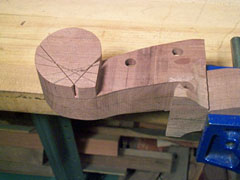
Rough Carving the Scroll
Now we begin roughing in the scroll.

 Using a tenon saw, we make a series of cuts tangential to (and about 1/32" outboard of) the pattern's tic marks. We cut down to the line defining the width of the scroll, stopping a little shy (unless you're not feeling shy). Keep making cuts until you make the first cut to intersect your beginning tangent.

 Then we knock out the deadwood with a mortising chisel and clean up with a rabbet (or rebate) plane and curved gouges. This brings the first rank of the scroll to a state ready for finish carving, and marked for the cove that will extend from the base of the peg shank around the full extent of the first rank of the scroll.
 Now we move the carving to the "carving board." Here we will deal with the second rank of the scroll This is an innovation I have recently adapted from an article by Guy Rabut, as described in American Lutherie (No. 52, winter 1997). It is quite an improvement to carving at the vise, as illustrated on the rest of this page.