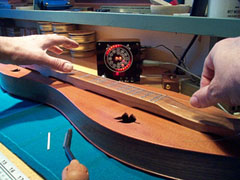
Setting the Intonation
Adjusting for the sharping effect of fretting a string is called "intonating." When a fretted stringed instrument will play accurately at all frets on all strings, it is "compensated".
I. Intonation
Briefly put, Intonation is achieved by moving the saddle further from the nut so the effective length of the string is a little longer, "flatting" the string to adjust for the sharping effect incurred in fretting. (Sometimes it is also advisable to move the nut also under one or more strings, but is not a general practice in dulcimer making.)
A plucked string generates a very complex mixture of frequencies of sound, not just one simple tone. Frequencies arise and decay throughout the duration of the tone coming from the string, creating a constantly varying mixture of different sounds and varying intensities, as the string, the body of the instrument, and the air inside the instrument's body interact. That is why the voice of plucked string instruments is so rich.
 Your ears are much more sensitive than an electronic tuner for this work, in discriminating the fundamental tone generated by this soup of sound. However, if you prefer an instrument, a stroboscopic tuner is a must for intonation. The PST-2 shown here is an excellent one. Among its several virtues, it can apply filters to the input to eliminate troublesome inharmonic components.
 Refine the tuning of your two strings so that they are exactly an octave apart. Rely on your ears' ability to hear beat tones, not on your electronic tuner. It will help to turn off the radio, the air conditioner, furnace blower, etc. If traffic noise outside is loud, choose a quieter time. Absolute quiet is required for this process.
- Strike the first harmonic of the bass string and listen for beats against the first string. They must be in absolute unison.
- Now fret the bass string at the 7th fret and shortly thereafter pluck the first string. These two should also be in unison. If the bass string is flat, slide the temporary saddle toward the nut, shortening the string. If the bass is sharp, slide the saddle away. Now go back and red-tune so that both strings are in unison.
- When you get a unison in both step 1 and 2, your bass string is now "intonated."
II. Compensation
If all the strings were of the same pitch, we would be done. But the bass strings are tuned lower than the treble strings in a musical instrument. Because we want all the strings to be under more or less equal tension, the bass strings must be much heavier. This effects how much sharping will occur, and that means that the bass side of the saddle will be a little further from the nut than the treble strings. So we have to intonate the treble and bass strings separately to compensate for this effect. This process of compensating for the greater weight and diameter of the bass strings is called "compensating the saddle," or simply "compensation." Having intonated the bass string, we now independently intonate the treble strings. That will compensate the saddle automatically.
- Re-check that your bass and first string are still in unison. Then fret the treble ("first") string at the 7th fret, then strike the bass string's second harmonic (approximately above the 3rd fret). They two tones should be in unison.
- If the first string is sharp, carefully move the temporary saddle further away--WITHOUT disturbing its position under the bass string. Similarly, if the first string is flat, move the saddle closer. Now go back to step 1. When you get a unison in both steps 1 and 2, go back to step 1 of Intonation and re-check. When you get a unison in all 4 steps, you are done.
Now use a sharp knife to cut a line into the fretboard against the front and back edge of the saddle, defining its true position. Congratulate yourself, for you have just intonated and compensated your musical instrument.
 The next step will be to cut a groove in the fretboard at that place, and fit a permanent saddle of the correct height into the bridge.