Musicians sometimes report, on receiving their new Bear Meadow, that the power and nuance of the instrument can be daunting, as if somehow exceeding their own art. It is to be hoped, of course, that – as with any great piece of art – as one becomes more familiar with their new Bear Meadow, one becomes more reliant on its capabilities as the norm, available for them wherever the music takes them and their new Bear Meadow Appalachian dulcimer. Your Bear Meadow is truly ready for anything that is demanded
To achieve such responsiveness and dynamic range in an acoustic dulcimer there are some steps that must be taken:
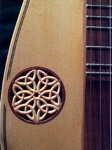 Tautness. The Appalachian dulcimer should be built with all members taut, ready to transmit any energy supplied by the musician. Every member of the instrument must have its proper built-in tension. Fortunately, the dulcimer doesn't operate under a great deal of stress, unlike a piano or guitar, so these stresses aren't great enough to tear the instrument apart. And they stay with the instrument through the years, instead of gradually relaxing. In taking an old Sunhearth or Bear Meadow apart for repairs, the stresses are still obvious if you know what to look for.
 Action. The action must be set properly for the individual player. Some will want a silky, light action that comes from light gauge strings and action set as low as possible. Others will want the "openness" and additional power that comes from a slightly higher action and heavier strings.
- Intonation. Many dulcimers achieve less than possible because they aren't intonated properly to be on pitch throughout the instrument's range. At Bear Meadow, accurate intonation is demanded through to the 14th diatonic fret. In order to achieve this, several factors must be achieved:
- Fretboard profiling. The dulcimer's large number of frets makes profiling the fretboard a delicate art. Think of a well-designed auditorium, where the floor is profiled such that in any seat one can just see over the heads in the next row. But toward the middle of the seating, the curve must change to avoid the audience having to look up more than necessary to see the stage. So the proper profile is something like a very shallow parabola, with its axis tilted a little back toward the first rows of the auditorium. This is a great model for thinking about fretboard profiling.
- Action. With a properly profiled fretboard, the action can be low enough to minimize the need to offset the sharping caused by pushing the string against the fret. Thus, the amount of intonation is minimized, enabling good intonation over a longer range.
- Strings. Strings must be chosen to fit each instrument in order to get optimum intonation all the way up the fretboard.
- Responsiveness. The musical instrument must give immediate evidence to the artist that it is ready for music. It must sound out powerfully at the slightest touch of the hand. Receiving a great stringed musical instrument can be challenging at first, as it demands of the musician a more nuanced style – a style that might not have gotten much satisfaction from an inferior instrument.
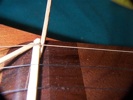 Proper sustain. In a highly responsive instrument with a powerful dynamic range, methods have to be developed for controlling sustain according the the needs of the music that will be played. A musician who wants to play fiddle tunes at speed will be unhappy with an instrument of great sustain. On the other hand, playing a more sensuous, nuanced repertoire will require as much sustain as possible, to be controlled as part of playing style.


Click for larger view
Dynamic Principles of the
Mountain Dulcimer