The Dulcimer Top
The dulcimer top is the primary tonal element in the dulcimer. Its construction, and the details of its relationship to the fretboard and the rest of the instrument is crucial to the voice of the dulcimer.
The top is a book-matched piece of redwood, about 0.080 inches thick. It has already been sanded to about 220 grit finish, and cut to a rough shape. Now it gets some bracing and soundholes.
 There are three braces in the top. These are made of scraps from clear redwood, sanded down to about 0.050 inches thick, and the edges are beveled also. These braces stiffen the thin redwood top at specific points and unify it acoustically, helping to shape its voice in the completed instrument. There are bow-tie braces at the bouts and a strap brace at the waist (or about midway between the bout and the peghead in the teardrop).
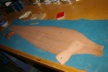
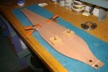 The top is sanded where the braces will go, so they will be glued to fresh, unoxidized wood. These joints are critical, for much vibrational energy will pass through them over the life of the instrument, and we don't want buzzes developing later.
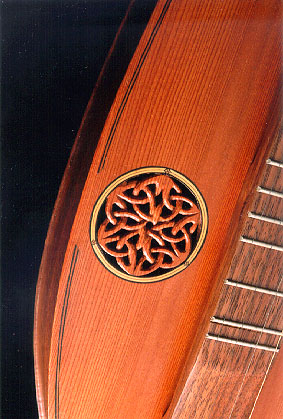
 Also, two of the braces serve as "doubling" to reinforce the carving of the soundholes, and for that reason also, we want a good firm, continuous seal between the two, to support the edges of the soundhole, which can have very delicate patterns in Bear Meadow Appalachian Dulcimers.

 After the glue has cured well, the purfling and soundholes are cut in. These may be simple "Bear Meadow" logos, tulip poplar leave motifs, or ornate Celtic knots, spirals, or other customized motifs. Sometimes days are spent on just one of the more detailed soundholes. The purfling is a simple inlaid band of black veneer--with a stripe of redwood in the middle. All inlays and marquetry are handmade at Bear Meadow, and are handled differently that customary lutherie purfling technique.
 After the top has been constructed, it is prepared for finishing. Two coats of a rare shellac, called "ruby shellac" is brushed on and rubbed out with 320-grit sandpaper or abrasive foam block. The color of this shellac will give an almost imperceptible warm glow to the redwood, as well as sealing it so the varnish doesn't fill the pores-that would deaden the acoustic response of the wood (sort of like filling your mouth with jello before singing). The bottom of the top gets two coats of shellac too, to protect the inside of the finished instrument from changes in temperature and humidity. The top is now ready to be joined to the fretboard.